
Tea Plant Types in Wuyi Yancha
Wuyi yancha is made from many different tea plant types, and their names and relationships can sometimes be confusing. This blog gives a general overview of these tea plants and presents them in several broad groups for easier understanding. The grouping refers to the tea plants themselves, rather than to finished yancha teas, and is only intended as a general way to organize the information. Only some representative examples are included under each group, rather than all of them.
I. Local Types
1. Wuyi Cai Cha (武夷菜茶, “Wuyi Native Tea”)
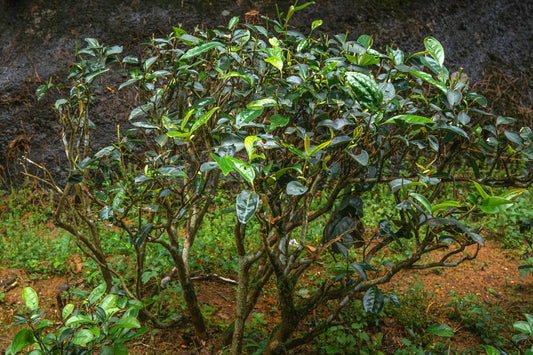
Wuyi Cai Cha, also called Qi Zhong (奇种, “Distinctive Variety”), is a native seed-propagated tea plant population in Wuyishan. It reproduces naturally through seeds. Because of natural crossing and genetic variation, each tea plant may show different characteristics, and the leaves can also vary in color from lighter to darker shades.
Today, there is not much Cai Cha left in Wuyishan. The main reasons are its relatively low yield and uneven bud growth. Because of this, much of it has been replaced by cultivars with better production characteristics.
1.1 Qi Zhong Wang (奇种王, “King of the Distinctive Variety”)
Qi Zhong Wang is regarded as the “Tea King” among Wuyi Cai Cha. It is located in Cha Wang Keng (茶王坑, “Tea King Valley”), on the mountain behind Tianxin Temple in Wuyishan. The tea tree is tall and large, with an estimated height of more than three meters. According to local accounts, it is at least one hundred years old.

(The tallest tea plant in the center of the photo is Qi Zhong Wang)
2. Ming Cong (名丛, “Famous Bushes”)
Because Wuyi Cai Cha is a seed-propagated population, the characteristics of its offspring are generally not stable. For this reason, superior individual plants were selected from the population and then propagated vegetatively, so that their desirable characteristics could be fixed and maintained. Among these many selected individual plants, some more outstanding ones were further selected and recognized as Ming Cong.
Typical Examples
Da Hong Pao (大红袍, “Big Red Robe”)
Tie Luo Han (铁罗汉, “Iron Arhat”)
Bai Ji Guan (白鸡冠, “White Cockscomb”)
Ban Tian Yao (半天腰, “Halfway to the Sky”)
Shui Jin Gui (水金龟, “Golden Water Turtle”)
Rou Gui (肉桂, “Cinnamon”)
Jin Suo Chi (金锁匙, “Golden Key”)
Bai Rui Xiang (白瑞香, “White Daphne”)
Zui Gui Fei (醉贵妃, “Drunken Noble Concubine”)
Yu Qi Lin (玉麒麟, “Jade Qilin”), and others.
2.1 Wu Da Ming Cong (五大名丛, “The Five Famous Bushes”)
In 1943, the tea scholar Lin Fuquan introduced five representative Wuyi tea cultivars in his work The Production, Processing, and Marketing of Wuyi Tea: Da Hong Pao, Tie Luo Han, Bai Ji Guan, Shui Jin Gui, and Ban Tian Yao. These five later became commonly known as the Wu Da Ming Cong (五大名丛, “The Five Famous Bushes”).
Compared with Wu Da Ming Cong, there are usually two different versions of the Si Da Ming Cong (四大名丛, “The Four Famous Tea Bushes”). One version includes Da Hong Pao, Tie Luo Han, Bai Ji Guan, and Shui Jin Gui, while the other includes Tie Luo Han, Bai Ji Guan, Shui Jin Gui, and Ban Tian Yao.
Today, most Wuyi yancha producers tend to use the second version, which does not include Da Hong Pao. The main reason is the special historical and cultural status of Da Hong Pao. Over time, Da Hong Pao became much more than the name of one Ming Cong. It became the best-known name associated with Wuyi tea and an important cultural symbol of Wuyi yancha itself. Because of this, it is often treated separately rather than simply as one member of the Si Da Ming Cong. In this way, the other four of the original Wu Da Ming Cong, Tie Luo Han, Bai Ji Guan, Shui Jin Gui, and Ban Tian Yao, are commonly referred to as the Four Famous Bushes.
3. Explanation of Related Terms
3.1 Hua Ming (花名, “Fanciful Names Coined for Teas”)
There are different explanations of the term Hua Ming. We consider one relatively reliable explanation to be the one given by Mr. Chen Dehua, a highly respected figure in the Wuyi yancha industry, in his book.
According to Chen, in the past, different yancha producers, for commercial considerations, gave finished Qi Zhong teas various names when packaging them. Based on their own cultural knowledge, they created these names to increase the value of the tea, appeal to the interests of tea buyers, and attract customers. Names such as Shui Zhong Xian (水中仙, “Immortal Upon the Waters”), Jin Liu Tiao (金柳条, “Golden Willow Branch”), and Ye Lai Xiang (夜来香, “Fragrance of the Night”) are examples of Hua Ming. These names were usually determined according to factors such as the appearance of the tea plant, its quality characteristics, aroma, taste, etc.
3.2 Xiao Pin Zhong (小品种, “Other Cultivars”)
Xiao Pin Zhong (小品种, “Other Cultivars”) is a colloquial term commonly used among people working in the Wuyi yancha industry, and it is sometimes shortened simply to Pin Zhong (品种, “cultivars”). Originally, the term referred to tea plants from the Wuyi Cai Cha population other than Rou Gui and Shui Xian. Over time, however, its meaning gradually changed, and it is now mainly used to refer to introduced cultivars and modern bred cultivars. (both categories are explained below)
II. Introduced Cultivars
This category refers to tea plant cultivars introduced from tea-producing areas outside Wuyishan. After being introduced and acclimatized to the local environment, they were found to be suitable for making yancha.
Typical Examples
Shui Xian (水仙, “Water Immortal”)
Fo Shou (佛手, “Buddha’s Hand”)
Ai Jiao Wu Long (矮脚乌龙, “Short-legged Oolong”)
Mei Zhan (梅占, “The Wintersweet Blossom Takes First Place”)
Qi Lan (奇兰, “Rare Orchid”)
Mao Xie (毛蟹, “Hairy Crab”)
Huang Jin Gui (黄金桂, “Golden Osmanthus”)
Ba Xian (八仙, “Eight Immortals”) and others.
1. Shui Xian (水仙, “Water Immortal”)
Although Shui Xian is one of the most representative cultivars used for Wuyi yancha, strictly speaking, it is an introduced cultivar. It originated in Dahu Village, Xiaohu Township, Jianyang, Fujian. According to records, it was discovered around 1821. It was introduced into Wuyishan for cultivation during the late Qing Dynasty, around 1875–1908, and has now been cultivated in Wuyishan for more than one hundred years.

2. Fo Shou (佛手, “Buddha’s Hand”)
Fo Shou originated in Yongchun County, Quanzhou, Fujian. According to local accounts, it was introduced into Wuyishan by tea merchants from Anxi around 1912–1927. When processed into yancha, it has a fresh and sweet taste, with a sweet aroma similar to snow pear. Because of this, people in Wuyishan also call it Xue Li (雪梨, “Snow Pear”). The fresh leaves of the Fo Shou tea plant are as large as a palm. The shape and texture of the leaves are also very similar to the leaves of Buddha's hand citron, which is where the name Fo Shou comes from.

3. Ai Jiao Wu Long (矮脚乌龙, “Short-legged Oolong”)
Dongfeng Town in Jian'ou, which is next to Wuyishan, is the place of origin of Ai Jiao Wu Long. It was also the location of Beiyuan, the imperial tea garden of the Song Dynasty. Ai Jiao Wu Long was introduced into Wuyishan at around the same period as Shui Xian.

III. Modern Bred Cultivars
This category refers to new tea plant cultivars developed since the 1980s by the Tea Research Institute of the Fujian Academy of Agricultural Sciences and used for making yancha.
They are improved cultivars developed through clonal selection and breeding. Their main characteristics include strong aroma, a high rate of producing good-quality finished tea, and strong resistance to unfavorable growing conditions. They were developed specifically with the processing requirements of Wuyi yancha in mind.
Typical Examples
Rui Xiang (瑞香, “Daphne”)
Huang Mei Gui (黄玫瑰, “Yellow Rose”)
Jin Guan Yin (金观音, “Golden Goddess of Mercy”)
Huang Guan Yin (黄观音, “Yellow Goddess of Mercy”)
Jin Mu Dan (金牡丹, “Golden Peony”)
Jiu Long Pao (九龙袍, “Nine-Dragon Robe”)
Chun Lan (春兰, “Spring Orchid”)
Dan Gui (丹桂, “Red Osmanthus”) and others.
Why Some Cultivars Are Known by Numbers
Each of these cultivars has a three-digit number, originally used as an identification code during the early experimental stage of cultivar development. Because these numbers are short and unambiguous, they are easy to remember and communicate, and they can also avoid confusion caused by differences in dialect pronunciation. Over time, the numbers of some cultivars have remained in common use within the Wuyi yancha industry and are now often used directly in place of the cultivar names. For example, 305 is commonly used to refer to Rui Xiang, while 105 is used for Huang Guan Yin.
1. Rui Xiang (瑞香, “Daphne”) / Cultivar code: 305
Rui Xiang is an oolong tea cultivar selected from the naturally crossed offspring of Huang Jin Gui (黄金桂, “Golden Osmanthus”) and then maintained through vegetative propagation.

bǎi ruì xiāng (百瑞香, “Hundred Daphne”) is an incorrectly used name. Over time, however, it gradually developed into a commercial name for Rui Xiang. This name does not exist in the official cultivar register.
By contrast, bái ruì xiāng (白瑞香, “White Daphne”) is a Ming Cong and has no relation to Rui Xiang.
2. Jin Guan Yin (金观音, “Golden Goddess of Mercy”) / Cultivar code: 204
Jin Guan Yin is a tea plant cultivar developed through controlled hybridization, with Tie Guan Yin (铁观音, “Iron Goddess of Mercy”) as the female parent and Huang Jin Gui (黄金桂, “Golden Osmanthus”) as the male parent. It is maintained through vegetative propagation. It is suitable for making oolong tea and black tea.

3. Jiu Long Pao (九龙袍, “Nine-Dragon Robe”) / Cultivar code: 303
Because the spring buds and young leaves of Jiu Long Pao are dark purplish-red, it is also commonly called Zi Hong Pao (紫红袍, “Purple Red Robe”). Jiu Long Pao is a tea plant cultivar selected from the naturally crossed offspring of Wuyi Da Hong Pao and maintained through vegetative propagation.

There is quite a bit behind the different tea plant names used in Wuyi yancha, from where they came from to how they are related to one another. This blog only covers some of the more common examples, but hopefully it gives a clearer picture of how these names fit together. It can still get confusing sometimes, especially when old names, local usage, and cultivar names overlap, but a basic outline of these relationships can at least make the different names a little easier to follow.