

Shi Ru
Regular price
$24.00
If you’re a beginner, we definitely recommend our Go-to Tea Sampler Box. It includes 8 different types of high-quality teas, allowing you to discover your favorite tea in the most affordable way.
For finest taste, tea should be stored in a place that is cool and dry.
Rock tea is best enjoyed within a 3-year period.
Black tea is best enjoyed within a 2-year period.
Green tea and Oolong tea are best enjoyed within a 2-year period.
White tea is an exception. Its internal compounds evolve over time, enhancing its fragrance and creating a deeper, mellower taste. Therefore, it does not have a specific optimal drinking period.
All packages are shipped from China. Please kindly note that our teas are prepared at our warehouse in Fujian, which usually takes no more than 72 hours. Once ready, package will be sent to an international shipping company in Shenzhen, then shipped to the destination country. International shipping typically takes 14-21 days.
If you run into issues while paying with PayPal, like the page getting stuck on loading, it’s usually due to a poor network connection. You can try switching to a different network or using another device. Alternatively, you can also try paying with a credit card instead.

Our teas all come from tea-making families. Some are made by our own family, and others are crafted by families we've known and trusted for years. Not from an unknown source, but from real people and family producers whose craft we trust and have seen in person.

It means you can actually taste where the tea comes from. It stays true to its own place, so the local soil, rocks, and climate all come through in the cup. With Wuyi rock oolong, you get that clear rock rhythm (Yan Yun) and a deep, lingering fragrance that only those rocky slopes can give. When you drink it, you're not just having a cup of tea, you're getting a small snapshot of that landscape.

We like to keep things honest and simple. When we share a tea, we share all the detailed information too, so you always know what you're drinking. We'd love to be the trusted tea partner you can turn to.
Click to learn more about our roast levels
The History Behind the Name Shi Ru
The name Shi Ru has a long and layered history. In 《宣和北苑贡茶录》(“Xuanhe Beiyuan Tribute Tea Record”) (1158) of the Song dynasty, Shi Ru was recorded as a tribute tea presented to the emperor and listed among the teas of “北苑贡茶” (“Beiyuan tribute tea”). However, since the Beiyuan tea region was centered around present-day Jian’ou, southeast of Wuyishan, this does not necessarily mean that the Shi Ru mentioned there came from the Wuyi Mountains.
By the Yuan dynasty (13th century), texts such as 《御茶园记》(“Record of the Imperial Tea Garden”) continued to use the name Shi Ru in reference to tribute tea from Wuyishan. The name is often understood to evoke tea trees growing from rocky crevices, their lush growth and rich sap compared to milk emerging from stone. Even so, these records do not clearly show whether Shi Ru was a general name for Wuyi tribute tea or the name of a specific tea.
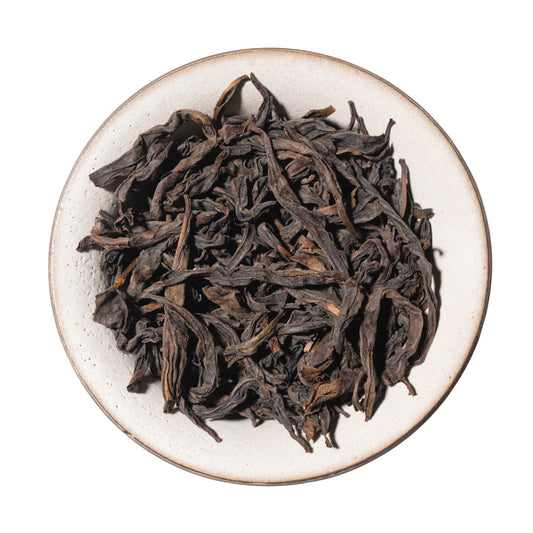
Today, Shi Ru, also known as Shi Ru Xiang (“Stone Milk Fragrance”), refers to a specific traditional Wuyi cultivar.
石乳留香 shí rǔ liú xiāng
One of the qualities most prized in Shi Ru is its lingering fragrance, captured in the phrase “石乳留香” (“Stone Milk Keeps Its Fragrance”). The phrase lives on not only in the experience of the tea itself, but also in a notable cliff inscription at the entrance to Jiulongke, in the Da Hong Pao scenic area, where it reflects both the historic stature of Wuyi yancha and the enduring cultural resonance of the ancient name Shi Ru.
Tea: 8g
Gaiwan: 110–150ml
Water Temperature: 100°C / 212°F
Use flash steeping (pour out the tea in about 3s). Do not oversteep. As the flavor begins to fade, extend each infusion by 5–10s as needed.
Note: Be sure to pour out the tea soup completely after each infusion. Do not let it sit in the gaiwan.
(Adjust the tea amount and steeping time to suit your own taste.)